


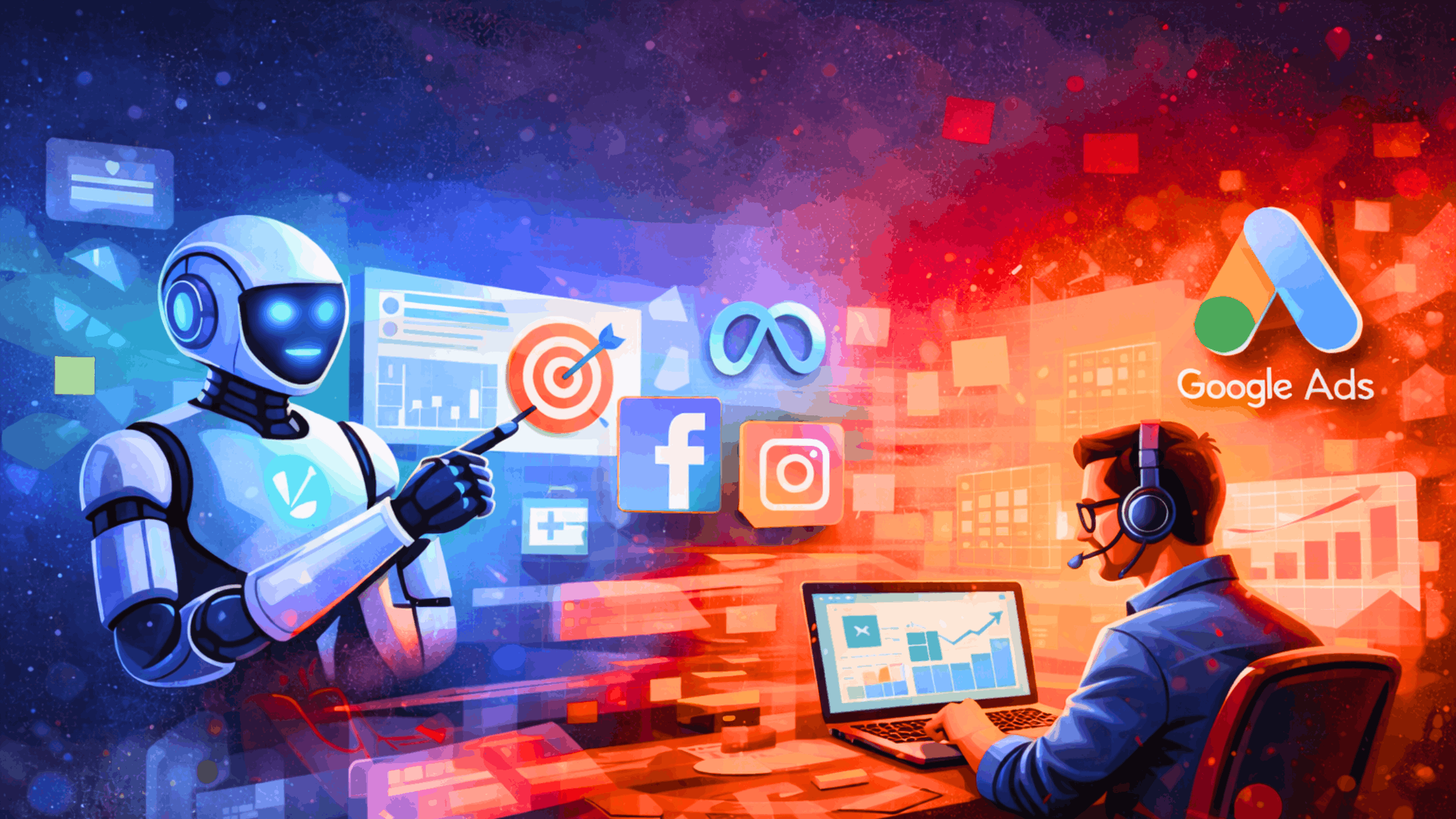
If you have worked in digital marketing over the past few years, chances are you have heard this sentence at least once:
“Just let the algorithm handle it. It knows better.”
For some, that sentence brings relief. For others, mild anxiety. And for a few, it triggers an immediate need to check whether their job is still safe. As usual, the truth lies somewhere in between. AI is indeed taking over a large part of ad optimization on platforms like Meta and Google Ads. However, this does not mean the end of performance marketing. It marks its evolution.
From Manual Control to Algorithmic Optimization
Not so long ago, performance teams spent hours adjusting bids, testing audiences, pausing ads with poor CTR, and manually searching for the perfect setup. Today, many of those decisions are made by AI:
- smart bidding models
- automated targeting
- dynamic creatives
- optimization based on real time conversion signals
In other words, platforms have taken over micro decisions and they are getting better at it every day.
What is important to highlight is this. AI does not optimize campaigns in a vacuum. It works only with what we give it, including goals, signals, structure, and data. This brings us to the first key point. AI is not a replacement for performance marketers. It is a tool that rewards good ones.
Why “Let the Algorithm Decide” Does Not Mean “Let Go of Everything”
Meta and Google are very clear about what they want:
- broader targeting
- less fragmentation
- more data per campaign
- clear and stable objectives
The goal of these guidelines is not to remove people from the equation. It is to help algorithms learn faster and more accurately. Still, the algorithm does not know:
- real business priorities
- market seasonality
- internal margins
- brand context
If we do not translate these factors through proper campaign and data structure, AI will optimize, but not necessarily in the right direction. In that sense, a good performance marketer today is not the person who constantly tweaks campaigns. It is the person who knows what not to touch and what to set up correctly from the start.
We Are Still in the Early Days of AI Advertising
Despite all the hype, it is important to stay realistic. AI in advertising is still in its early stages. Algorithms are powerful, but they are far from flawless. We have all seen cases where:
- a campaign learns the wrong users
- the algorithm pushes volume at the expense of profitability
- short term metrics look great while long term performance suffers
This is where the difference between an average and a high quality performance marketer becomes obvious. Not in who has a better trick, but in who knows how to read data in context. AI sees patterns, but it does not yet understand the business implications behind them. At least not yet.
Skeptics, Manual Marketers, and the A/B Test Between Humans and Algorithms
Let us be honest. Everyone in performance marketing knows at least one colleague, or maybe it is us, who responds to AI optimization with:
“Sure, it is fine, but I will still do it manually for now.”
And that is completely fine. Skepticism is not a weakness. It is a professional reflex. Performance marketing is an industry built on testing and proof. So why should AI be any different? That is why many teams today, consciously or not, are doing the most logical thing. They are testing manual setups against AI driven optimization.
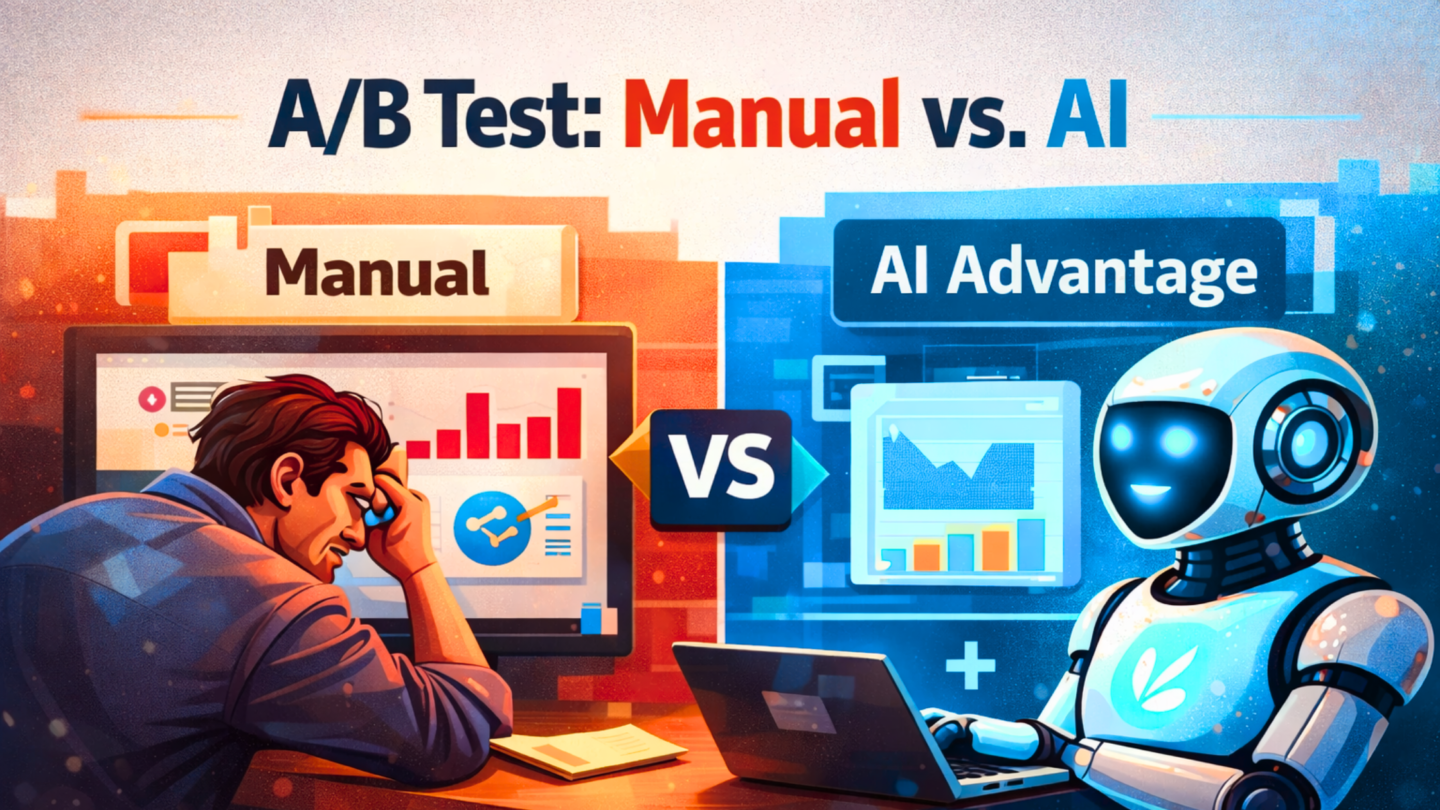
On one side, there is a campaign managed manually. On the other side, there is a campaign using automated bidding, broad targeting, and algorithmic optimization. In the background, the performance marketer watches the results and quietly hopes to prove that they are still in control.
The truth is that letting go of manual control is not easy. Not because AI does not work, but because manual work gives us a sense of certainty. We clicked something. We changed something. We did something. AI, on the other hand, often appears to be doing nothing at first glance. A marketer who does not touch a campaign for three days can look like they are not doing their job, even when they are doing exactly the right thing.
What practice increasingly shows is this. AI usually wins when it comes to scalability and stability, while manual approaches can still shine in specific situations, niches, or when foundations are poorly set. That is why this phase is not a battle between AI and marketers. It is a transition phase where we learn how to work with the algorithm instead of competing against it.
Perhaps the healthiest takeaway for skeptics is this. Testing AI against manual approaches is not the problem. Failing to learn anything from that test is. The moment we stop measuring ego and start measuring structure, data, and long term signals, AI stops being a threat. It becomes a colleague who never slacks off, never panics daily, and never takes a vacation.
Data Is the Fuel, Structure Is the Engine
One of the most underestimated topics in AI advertising is data structure. Meta and Google algorithms depend heavily on the quality and consistency of signals:
- properly set up conversion events
- clean and logical campaign structures
- meaningful ad set grouping
- consistent segmentation
This is where manual work still plays a crucial role. Not in day to day tweaking, but in designing the system in which AI operates. Bad structure combined with good AI leads to quickly scaled bad decisions. Good structure combined with good AI leads to sustainable growth.
AI as an Accelerator, Not an Autopilot
Marketing expert Andrew Foxwell often emphasizes that AI is not a fire and forget solution. It is a system that requires strategic guidance. Rand Fishkin shares a similar view and warns that automation without understanding can lead to beautiful dashboards and bad decisions.
In other words, AI can move very fast, but someone still needs to know where the business is going.

If you have ever watched a performance marketer panic and shut down a campaign because CPA jumped twelve percent in the last two hours, you know we are not always the algorithm’s best friend. AI does not panic. It remembers. And it often returns the favor later.
One of the biggest lessons of this phase may be this. Less impulsiveness. More trust. Built on solid foundations.
What Does This Mean for Clients and Agencies
For clients, this means agencies that understand AI are not less involved. They are more strategically involved. Value is no longer measured by the number of optimizations, but by the quality of thinking, structure, and data interpretation.
AI may take over optimization, but responsibility for results remains human.
Conclusion: The Beginning, Not the End
AI in advertising is not a threat to performance teams. It is a test of their maturity. Those who embrace Meta’s and Google’s new direction while maintaining analytical thinking and strategic perspective will achieve better results. Others will continue wondering why the algorithm does not work like it used to.
This is just the beginning of the story. In the next installments, we will explore what it really means to be a performance marketer today and which skills become critical in a world where algorithms make most of the decisions.
Sources and Recommended Reading:
Google Ads Help Center – Smart Bidding & Automation
Google Research – Machine Learning in Advertising Systems
Andrew Foxwell – blog i LinkedIn objave o Meta Ads automatizaciji
Rand Fishkin – komentari o automatizaciji i marketinškim metrikama
McKinsey & Company – The impact of AI on marketing performance


