



In a time when every digital platform is looking to leverage AI to improve the user experience, Google’s answer to such trends is – Search Generative Experience (SGE). From the user’s perspective, SGE can be a handy shortcut to the information you are looking for, but from the perspective of content creators and SEO experts, Google’s new tool can cause a lot of headaches. Therefore, while there are many reasons to rejoice, but also to worry, so it is well worth considering what this Google novelty brings.
What is Google Search Generative Experience?
Let us start by answering the basic question – what is SGE? Google Search Generative Experience (SGE) is Google’s search experience innovation powered by generative AI. It combines the power of artificial intelligence with traditional search to provide users with more personalized and precise results, arranged in a clearer and more concise way. SGE is also the result of Google’s advances in language model processing and machine learning.
As they state in Google’s digitalbrochure on SGE this technology will allow users to:
- ask more complex and descriptive questions.
- summarize information faster while offering relevant links for further search;
- generate desired content more easily;
- perform further research more easily with additional questions and suggestions.
How Google Search Generative Experience works?
Google SGE uses generative artificial intelligence, i.e. algorithms or models that can create all forms of content by themselves – from texts and images to lines of code. This artificial intelligence is based on large language models (LLMs) that train their understanding of literally everything on huge amounts of data. The LLM on which ChatGPT works is GPT-4, while the Google’s equivalent’s name is PaLM 2 – Pathways Language Model 2.
All other Google tools that use artificial intelligence are based on PaLM 2 technology. (If you cannot think of any, it is not surprising because almost nothing is available in Croatia.) What does this mean for the user? That Google Search Generative Experience with the help of PaLM 2 will better understand the query, generate a field with basic information faster, do it in a beautiful way and with an understandable, conversational language.
SERP’s look with SGE: greater personalization and visibility
SGE brings users a visually improved search experience. The interface is enriched with multimedia elements, such as images, videos, and charts, providing users with a more comprehensive overview of information. This improved interface makes searching simpler and more efficient, and it looks like this:
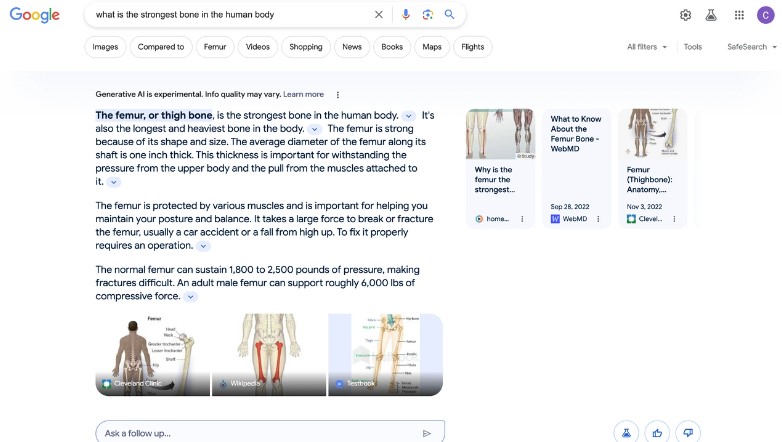
Looks great, like something you cannot wait to get on your computer? If the answer is ‘yes’, that is expected, but you will have to wait. Our speaking area was nowhere close to the latest Google Search Lab expansion necessary for the use of the SGE, and it included as many as 120 countries. However, if you think about it, the format is already somewhat familiar. Reminds of the (already available!) Bing chat option that also serves short answers accompanied by links for more information, and in some places, photos:


The fact that these two technologies resemble each other is not overly shocking because both companies – Google and Microsoft – know what users need. However, it is obvious that while Google may be a little late with SGE, Bing’s UX/UI teams cannot even hold a candle to those from Google. SGE just looks better.
Challenges that Google Search Generative Experience brings to the SEO industry
Everything we have written so far in this blog about Google SGE technology has led to this moment – a small mental breakdown due to the possible implications for SEO practices.
The dream of every SEO expert is to sit at the top of the SERP (first search engine results page) results. It used to be possible. Then commercials were pushed to the top. Then, in addition to these ads, Google snippets with already prepared answers crept in. It was already challenging, but we accepted it because we counted on the possibility that most users would just skip the ads, (very far-fetched) maybe not finding the answer among the options offered and they would finally reach the positions we fought for with our SEO hands and feet.
However, Search Generative Experience will not only take away a bit more space on the SERP, but will potentially offer all the answers right at the top of the page, without the need for the user to search further. Shoot.
So, it will be necessary to harness your brain and come up with some new SEO strategies and tactics. Here are four steps that, if you have not taken yet, it is high time you did.
1. Tackle long tail keywords
Keywords that contain three or more words are a huge treasure trove of additional traffic, and this has been known for a long time. However, SGE itself can also be helpful in finding them, which in its ‘foreign’ versions, in addition to the presented results, offers additional prompts and a selection of follow-upquestions. Time will tell if these suggestions are the result of Google’s knowledge of your search history (as it is speculated that the current terms in Google searches are pre-offered). Certainly, as ideas they cannot hurt.

2. If you have not already, start using Schema.org and structured data
Structured data are pieces of code that can be inserted into the structure of a page. They are not visible to users, but they are an additional signal to Google crawlers on what the page is about. Structured data can highlight important information about the content that you want to rank on Google. For example – for the course, emphasize its description, duration, price, venue, for the recipe, the duration of preparation, ingredients, and the like. It is important that you only add what is already on the corresponding page to the structured data.
While creating structured data you can use the help of the following:
- Shema.org where you can find code previews for different types of information you want to highlight;
- a markup generator (like this one) which can shorten the work of code writing;
- Google’s Rich Results Test where you can check if your structured data are well organized and what Google will infer about the content from it.
3. Think about optimization of photos and graphics
If you find the visual you use on your website informative, optimize the file name, alt text, size. In this way, you signal to Google that this piece of content also hides valuable information that can be a direct response to user queries.
4. Write quality content in understandable language
‘Content is king’ is an old motto that is valid at all times, even at the one after the arrival of Google Search Generative Experience. Make an effort to come up with informative blogs that teach and give in-depth insight into a topic. Write down, include (optimized!) subheadings and paragraphs, lists, infographics, additional links to related pages. In doing so, think very carefully about what type of search intent the content corresponds to – informational, navigational, commercial or transactional.
Above all, the most important thing is that the language you write in is simple and understandable. This is particularly important due to the prevalence of voice searches, which, according to the Demand Sage, account for as much as a fifth of the total examinations. Imagine how you would ask a question about a topic or product. Say it out loud. If it sounds right, that is the way you want to go.
Is it time to move over to new business due to SGE-a?
At the end of this text, it is important to reassure those sceptical about the future of their own business and the impact of SGE on SEO that: No. Need. To. Panic.
New content will always be needed and someone will need to arrange it properly. AI, including Google Search Generative Experience, learns from pre-existing content. Who will bring new discoveries, knowledge and experience under its nose? We are the ones who create the content. SGE can only push us to either put more effort into our websites or pay to push our way to the top. So, business as usual.
As the experts from the Facebook group SEO Hrvatska say (join if you want to follow the novelties in SEO and learn from others), in 2024 SGE will probably bypass us. But once it comes… Users will have a better experience, but for us, everything else remains the same – we will roll up our sleeves and continue to work diligently, as before.


